

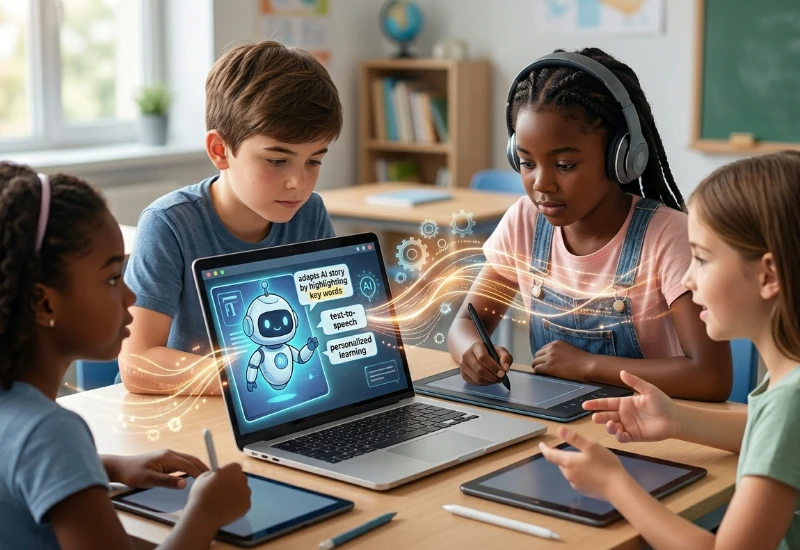
The AI impact on dyslexia is quickly becoming one of the most promising developments in education today. For years, students with dyslexia have faced learning environments that weren’t built with their needs in mind. Traditional methods often rely heavily on reading and writing, which can create frustration instead of progress. But now, AI tools for dyslexia are changing that experience in meaningful ways.
Artificial intelligence isn’t about replacing teachers or simplifying learning. It’s about offering smarter, more personalized support. From assistive technology for dyslexia to real-time reading help, AI is making learning more accessible, flexible, and encouraging for students who learn differently.
If you’re a parent or educator, you’ve probably wondered: Can technology really make a difference? The answer is yes, but it works best when used thoughtfully. In this guide, we’ll break down how AI supports dyslexic learners, what the latest research shows, and how you can use these tools in everyday learning.
Why Traditional Learning Methods Fall Short
Many classrooms still follow a one-size-fits-all approach. For students with dyslexia, that can feel like trying to keep up in a system that moves too fast and leans heavily on reading.
Standard instruction often assumes that students process written language the same way. But dyslexia affects how the brain recognizes and decodes words. Without the right support, students may fall behind even when they’re capable and motivated.
Another challenge is delayed identification. According to research published on ScienceDirect, early detection is critical, yet many students aren’t identified until they’ve already struggled for years.
This gap can impact more than academics. Confidence often takes a hit, and students may begin to disengage. That’s where AI has the potential to step in earlier and more effectively.
Importance of AI in Education
AI is becoming especially important because it helps bridge gaps that traditional teaching methods often miss, particularly for students with dyslexia.
In a typical classroom, lessons move at a set pace and rely heavily on reading and writing. For a student with dyslexia, that can create constant barriers. AI changes that by adapting in real time. If a student struggles with a word or sentence, the technology can slow things down, read it aloud, or present it in a clearer, more accessible way.
This kind of support isn’t just helpful, it can be transformative. It allows students to stay engaged, understand material more fully, and build confidence instead of frustration.
You’ve likely seen some of these tools in action:
- Text-to-speech tools that read content aloud
- Speech-to-text tools that make writing easier
- Programs that simplify or restructure complex text
These tools don’t replace teachers or proven learning methods. Instead, they strengthen them. They give students with dyslexia another pathway to access information, participate in learning, and succeed alongside their peers.
How AI Is Helping Students with Dyslexia
Personalized Learning That Adapts
One of the most meaningful benefits of AI is its ability to personalize learning in a way that simply wasn’t possible before. Instead of expecting students to keep pace with a fixed curriculum, AI allows instruction to adjust to the student.
For students with dyslexia, this can make a significant difference. Reading challenges often have little to do with intelligence and everything to do with how information is presented. AI tools can respond to that in real time, adapting reading levels, slowing down or speeding up pacing, and even changing how content is delivered, whether through audio, visuals, or simplified text.
This flexibility helps remove unnecessary barriers. Students are less likely to feel overwhelmed and more likely to stay engaged with the material. Over time, that leads to stronger comprehension, greater confidence, and a more positive learning experience overall.
Real-Time Reading and Writing Support
AI can provide instant feedback, which is a game changer. Students don’t have to wait for help. If they struggle with a word or sentence, support is immediate.
Tools can read text aloud, highlight key parts, or suggest corrections while writing. This creates a smoother, less stressful learning experience.
Earlier Identification of Dyslexia
One of the most promising developments in AI is its ability to support earlier identification of dyslexia. Traditionally, dyslexia is often diagnosed only after a child has already struggled with reading for some time. This delay can make it harder to close learning gaps and can affect a child’s confidence.
AI has the potential to change that timeline. By analyzing patterns in how a student reads, writes, or even forms letters, AI tools can detect early indicators that might otherwise be missed. For example, subtle differences in handwriting, spelling patterns, or reading fluency can signal a need for further evaluation.
These insights don’t replace formal diagnosis, but they can serve as an early alert system. According to insights shared by eSchool News, AI-driven tools are already helping educators recognize learning challenges sooner, allowing for faster and more targeted support.
Earlier identification means earlier intervention, and that can make a lasting difference. When students receive the right support at the right time, they are far more likely to build strong foundational skills and maintain confidence in their ability to learn.
Building Confidence and Independence
When students can work through challenges on their own, confidence grows. AI tools give them more control over their learning.
Instead of relying on constant assistance, they can explore, learn, and succeed independently.
Real-World AI Tools Supporting Dyslexic Learners
AI tools for dyslexia don’t need to be complicated to be effective. Many are already part of everyday technology.
Reading tools can convert text into audio, making content easier to absorb. Writing tools can help organize thoughts and correct spelling without interrupting the flow of ideas.
Multisensory tools are especially helpful. They combine audio, visuals, and interaction, which aligns well with how many dyslexic students learn best.
If you’re looking for a starting point, exploring structured literacy approaches alongside technology can be helpful. Resources like dyslexia reading support strategies can provide a strong foundation.
What Research Says About AI and Dyslexia
Recent studies are encouraging. Research available through ScienceDirect shows that AI-supported tools can improve reading comprehension and engagement.
Other findings suggest that AI can help identify dyslexia earlier and more accurately. This allows for quicker support, which is key to long-term success.
Organizations like LDRFA.org and The Windward School also emphasize the importance of combining technology with proven teaching methods. AI works best when it supports structured, evidence-based instruction.
In short, AI isn’t a standalone solution. It’s a powerful addition to the right educational approach.
Things to Keep in Mind about AI Impact in Education
While AI offers many benefits, it’s not a magic fix.
Over-reliance on technology can be a concern. Students still need strong foundational skills, especially in reading and writing.
Accuracy is another factor. AI tools can make mistakes, so human guidance remains essential.
Privacy also matters. When using AI tools, it’s important to choose platforms that protect student data.
Used thoughtfully, AI can be incredibly helpful. The key is balance.
How Parents Can Support a Child with Dyslexia at Home Using A
You don’t need to completely change your daily routine to start supporting a child with dyslexia. Small, consistent steps, especially with the help of AI tools, can make a meaningful difference over time.
Start simple. Tools like text-to-speech can read assignments aloud, while speech-to-text can help your child express their ideas without getting stuck on spelling. These supports can reduce frustration and make homework feel more manageable.
Just as important is your encouragement. For children with dyslexia, progress can take time, so it’s important to focus on effort and growth rather than perfection. Celebrating small wins helps build confidence and keeps motivation strong.
Technology works best when paired with proven strategies. Combining AI tools with structured approaches can reinforce learning in a supportive way.
How Educators Can Use AI to Support Students with Dyslexia in the Classroom
For educators, AI offers practical ways to better support students with dyslexia without adding more complexity to an already full workload. One of the biggest advantages is differentiation. Instead of creating multiple versions of the same lesson, AI tools can automatically adjust reading levels, pacing, and content format based on each student’s needs.
This is especially valuable for students with dyslexia, who may need information presented in different ways to fully understand it. AI can provide options like audio support, simplified text, or guided reading assistance, helping students stay engaged with the same core material as their peers.
Another key benefit is immediate feedback. Students don’t have to wait for corrections or clarification. They can get support in real time, which helps prevent frustration and keeps learning moving forward. This also gives teachers more time to focus on instruction, small-group support, and building strong relationships with students.
Most importantly, AI helps create a more inclusive classroom environment. When students with dyslexia have access to the tools they need to succeed, they can participate more confidently. And when classrooms are designed to support diverse learning needs, every student benefits.
The Future of AI and Dyslexia Support
AI is still evolving, and the future looks promising.
We’re seeing more adaptive tools that respond in real time. There’s also growing interest in combining AI with immersive learning experiences.
As technology becomes more accessible, more students will benefit from these tools. That means fewer barriers and more opportunities for success.
Final Thoughts
AI is opening new doors for students with dyslexia. It’s not about replacing traditional learning. It’s about making learning more accessible, flexible, and supportive.
For parents and educators, the goal isn’t to rely entirely on technology. It’s to use it as a tool that empowers students to succeed.
With the right balance, AI can help turn challenges into opportunities and create a more inclusive future for every learner.
Sources
- Artificial Intelligence and Dyslexia Research Study. (2026). ScienceDirect.
https://www.sciencedirect.com/science/article/pii/S1560429226000144 - How AI is transforming learning for dyslexic students. (2024, December 4). eSchool News.
https://www.eschoolnews.com/innovative-teaching/2024/12/04/how-ai-is-transforming-learning-for-dyslexic-students/ - Leveraging technology to empower students with dyslexia. (n.d.). The Windward School Institute.
https://www.thewindwardschool.org/institute-blogs/leveraging-technology-to-empower-students-with-dyslexia/