

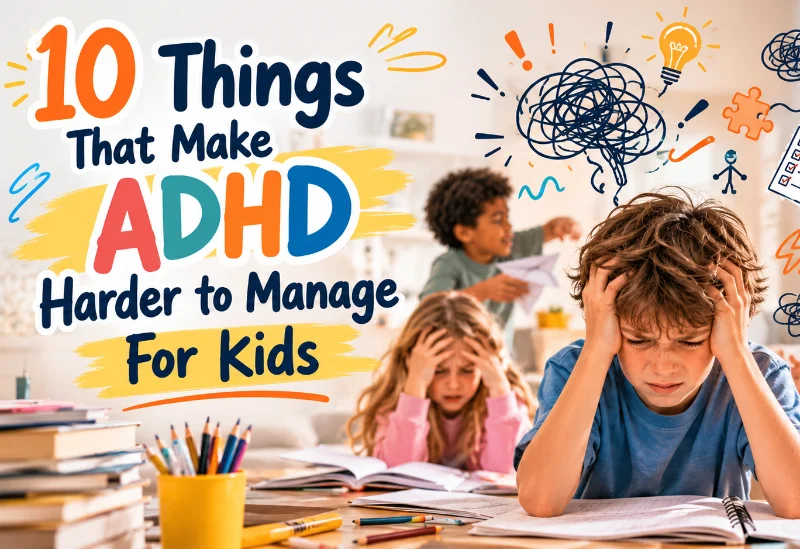
Managing ADHD is possible. But certain habits, environments, and daily patterns quietly work against even the best treatment plan.
About 7.1 million children in the U.S. have been diagnosed with ADHD, according to the 2022 National Survey of Children’s Health. Millions more adults live with it, many without a formal diagnosis. Treatment helps. Medication helps. But what happens outside the doctor’s office matters just as much.
Some of the most common ADHD triggers are also the most overlooked. Not because they’re complicated, but because they feel ordinary. Skipping breakfast. A cluttered bedroom. A bad night’s sleep. These things affect everyone, but they hit harder when the brain is already working differently.
This article covers 10 of them, for kids and adults both.
1. Not Getting Enough Sleep
Sleep deprivation is brutal for any brain. For a brain with ADHD, it’s particularly damaging.
Poor sleep sharpens the very symptoms that ADHD already makes difficult: focus, emotional regulation, impulse control. A child who slept badly shows up to school looking defiant or distracted when they’re actually exhausted.
ADHD also makes sleep harder to come by. Racing thoughts, delayed melatonin release, and difficulty winding down are common. It becomes circular fast.
A consistent sleep schedule, a screen-free bedroom, and a calm bedtime routine help more than most people expect. It sounds basic. It works.
2. Too Much Screen Time
Screen time isn’t inherently the enemy. Assistive technology, reading apps, and educational tools have genuine value for kids with ADHD and learning disabilities.
Passive screen use is a different story. Scrolling, autoplay video, and gaming for hours on end feed a dopamine loop that makes real-world tasks feel impossibly dull by comparison. Focus gets harder. Homework becomes a battle. Kids can find themselves avoiding school work in favor of endless browsing without realizing why.
There’s also the sleep connection. Screens before bed delay sleep onset, which feeds directly into the first problem on this list.
The goal isn’t zero screens. It’s purpose. Thirty minutes of deliberate screen time is different from three hours of drifting.
3. Skipping Breakfast
Blood sugar drops quietly and causes real damage to attention and mood. Kids who skip breakfast are working at a deficit before the school day even starts.
For kids with ADHD, mornings are already chaotic. Eating feels low-priority when there are so many things they need to do to get ready for their day. But skipping it leads to energy crashes by mid-morning, increased irritability, and difficulty staying on task.
There area additional problems for kids who take medications. Many ADHD medications suppress appetite, which can make breakfast feel unnecessary. The guidance from most clinicians is to eat something before the medication kicks in, even a small amount of protein.
A hard-boiled egg. A handful of nuts. It doesn’t need to be elaborate.
4. A Diet Heavy in Sugar and Processed Foods
The research on diet and ADHD is still developing, and no specific food causes ADHD. What the evidence does suggest is that processed foods, artificial colorings, and high-sugar diets can worsen symptoms, particularly in children.
Food additives have been linked to increased hyperactivity in some kids, with or without an ADHD diagnosis. Sugar crashes cause attention lapses and mood swings that look a lot like ADHD symptoms even when they’re not.
For parents who have kids with ADHD the challenge is different. Cooking requires planning, sequencing, and follow-through. Eating out more often follows naturally, but restaurant food is loaded with sodium, fat, and refined carbohydrates.
Small shifts beat total overhauls. Protein-rich snacks, fewer processed foods at home, water over soda.
5. Too Little Physical Activity
Exercise does something specific for ADHD brains. Physical activity raises dopamine, norepinephrine, and serotonin levels in the brain, the same chemicals that ADHD medications target. According to John Ratey, M.D., associate clinical professor of psychiatry at Harvard Medical School, exercise “turns on the attention system, the so-called executive functions, sequencing, working memory, prioritizing, inhibiting, and sustaining attention.”
For kids, physical activity at school and after school matters. Cutting gym class or recess to make room for more academic time has real consequences for kids with ADHD. Movement helps them focus during the sitting parts of the day.
6. Clutter and Disorganized Spaces
A messy room isn’t just untidy. For someone with ADHD, it’s a constant source of incoming demand.
Every pile of papers, every unfinished project left on the floor, every thing that needs to be dealt with “later” competes for attention. The ADHD brain has difficulty filtering visual noise. All of it registers. All of it adds to the mental load.
For kids, a chaotic backpack or desk means lost assignments, missed deadlines, and that familiar sinking feeling of knowing something was due but not being able to find it. For adults, a disorganized workspace slows everything down.
Clear surfaces help. Labeled bins help. Physical inboxes that sort what’s urgent from what can wait help more than most people expect. The goal isn’t perfection. It’s removing unnecessary friction.
7. Chronic Stress
Stress temporarily reduces frontal lobe function in everyone. In people with ADHD, the frontal lobe is already working harder than usual to manage focus, planning, and impulse control. Add sustained stress and the gap becomes wider.
For kids, common sources are social pressure, academic struggle, fear of being called on, and the accumulated effect of feeling different or behind.
There’s a specific response some people with ADHD experience under high stress called ADHD paralysis. The to-do list grows, the pressure builds, and the result is complete inaction. Not laziness. The nervous system shutting down under overload.
Smaller tasks. Shorter lists. Asking for help earlier rather than later.
8. Untreated Co-Occurring Conditions
ADHD rarely shows up alone. Anxiety, depression, dyslexia, sensory processing differences, and sleep disorders commonly overlap with it.
When those conditions go untreated, ADHD symptoms get harder to manage. Anxiety and ADHD together look different from ADHD alone. Depression affects motivation in ways that overlap with inattention. Dyslexia adds a layer of academic struggle that compounds frustration and self-doubt.
This matters for treatment. Addressing only the ADHD while ignoring co-occurring anxiety, for example, often produces incomplete results.
It also matters for identification. Girls and women with ADHD are more likely to have their symptoms masked by anxiety or attributed to mood, leading to late or missed diagnosis.
A thorough evaluation looks at the full picture, not just the most visible symptoms.
9. Lack of Routine and Structure
The ADHD brain depends on external structure because internal regulation, the ability to self-direct and self-sequence, is genuinely harder with this condition.
Predictable routines reduce the decision-making load. When the sequence of events is automatic, less executive function is spent figuring out what comes next. Disruptions to routine, starting a new school year, doing your homework, making new friends hits kids with ADHD harder than most people realize.
Flexible schedules sound appealing but often remove the very scaffolding that kept symptoms manageable.
For kids, after-school routines that establish homework time, snack, movement, and downtime in a consistent order reduce the nightly battles significantly. Visual schedules work better than verbal reminders for most kids with ADHD.
10. Stopping Treatment Too Soon
When ADHD symptoms improve, it’s tempting to conclude that treatment is no longer necessary. This is one of the more common reasons symptoms return.
Medication helps with the neurological side. Therapy and behavioral support build the strategies and habits that keep daily life functional when medication alone isn’t sufficient. Both matter. Removing one while the other continues often produces incomplete results.
For kids, parents sometimes pause medication over school breaks or after a run of good report cards. For adults, therapy is often dropped when finances get tight or schedules get busy. Both are understandable. Both carry real risk.
If cost or access is the barrier, telehealth options have expanded significantly and are often more affordable than in-person visits.
The right treatment, at the right dose, honestly discussed with your provider, is worth protecting.
ADHD and Learning Disabilities: When Both Are Present
ADHD and learning disabilities like dyslexia frequently occur together. According to the International Dyslexia Association, it is estimated that 30% of those with dyslexia have coexisting ADHD.
When both are present, the triggers covered in this article become compounding. Poor sleep disrupts reading fluency and attention. Stress from academic struggles worsens focus. Disorganized environments make already-difficult tasks feel impossible.
The good news is that the strategies overlap too. Better sleep, structured routines, and treating co-occurring conditions help both.
If your child has been identified with a learning disability and you suspect ADHD is also present, or the other way around, a comprehensive educational or psychological evaluation can identify what’s actually driving the challenges. LDRFA’s helpline can help connect families with the right resources.
Signs These Triggers May Be Affecting Your Child at School
- Homework consistently takes two to three times longer than expected
- Emotional meltdowns happen regularly after school
- Teachers are reporting the child seems distracted or “not there”
- Assignments are lost frequently, even when completed
- Your child says they “don’t know” what was assigned
- Sleep battles happen almost every night
- Mornings involve significant conflict or delays
None of these alone is diagnostic. But a pattern across several of them is worth paying attention to.
When to Talk to a Doctor or Specialist
If several of the triggers in this article feel familiar, and they’re consistent rather than occasional, it’s worth raising them with your child’s pediatrician or your own doctor.
Be specific. “My child can’t focus” is harder to act on than “my child sleeps fewer than eight hours, skips breakfast most days, and has three meltdowns a week.” Details give clinicians something to work with.
LDRFA’s helpline is also available for families navigating learning disabilities, ADHD, and related challenges. Our team can help identify resources, connect you with specialists, and answer questions about evaluations and support options.