


Executive dysfunction makes simple tasks feel impossible. Not because you lack intelligence or motivation, but because the brain’s management system misfires. Planning dinner, starting a work project, remembering an appointment you set 20 minutes ago, these become daily battles when executive functions break down.
About 90% of people with ADHD experience executive dysfunction. But it also shows up in people with depression, anxiety, traumatic brain injuries, autism, and neurodegenerative conditions. The National Institute of Mental Health estimates that 4.4% of American adults have ADHD, and the majority of them deal with executive function deficits that go undiagnosed for years.
This guide covers what executive dysfunction actually looks like in adults, what causes it, how it gets evaluated, and what works for managing it day to day.
Often people with ADHD are also symptomatic of Executive Functioning Disorder. ADHD symptoms manifest as executive function deficits in cognitive skills such as planning, time management, executing tasks, organizing thoughts, achieving targeted goals, and problem-solving.
Do you have a feeling that you or a loved one may suffer from an executive function disorder?
Executive function disorder refers to a broad group of mental skills that enable individuals to interact with others and complete tasks, including planning, organizing, multitasking, time management, problem-solving, and controlling behaviors and emotions. If someone has an executive function disorder, it can impair them from controlling their behavior and organizing their tasks.
Conversely, most of the people who suffer from EFD also have ADHD as the two go hand in hand as most attention-deficit ADHD symptoms manifest as executive function deficits.
People who suffer from EFD usually have planning and time management difficulties executing tasks, organizing their thoughts, and often difficulty achieving their goals and struggle with problem-solving.
But, how can you tell whether or not someone suffers from executive function disorder?
Check out this guide to learn about the top signs and symptoms of executive function disorder.
Video: What is Executive Function and Why Do We Need it?
What is Executive Function Disorder?
Executive functions are the brain’s command center. They handle the mental skills you need to get through daily life: planning, organizing, managing time, controlling impulses, regulating emotions, holding information in working memory, and switching between tasks.
The prefrontal cortex controls these functions. When it works well, you can break a large project into steps, estimate how long each step takes, start on time, adjust your approach when something isn’t working, and finish what you began.
Executive dysfunction happens when one or more of these skills is impaired. The person knows what they need to do. The gap is between knowing and doing.
Russell Barkley, Ph.D., one of the leading researchers on executive function and ADHD, describes it this way: the individual does not lack knowledge of what to do, yet somehow the task does not get done.
All children with ADHD suffer on some level with their executive function skills. And, it also typically affects children who learn and think differently. Adults can also suffer from executive function disorder.
However, it’s important to keep in mind that executive functions are fully developed by the age of 25. This means that you can’t develop an executive function disorder later in life (past the age of 25).
Six clusters of executive function tend to be affected:
Activation. Organizing tasks, estimating time, and getting started. Adults with activation problems can stare at a to-do list for an hour without beginning any of the tasks on it.
Focus. Sustaining, finding, and shifting attention when needed. This includes hyperfocus, where someone locks onto one task for hours while ignoring everything else, and distractibility, where concentration breaks every few minutes.
Effort. Regulating alertness, sustaining motivation, and managing processing speed. Some tasks feel like pushing through wet concrete, even when the person wants to complete them.
Emotion. Managing frustration and modulating feelings. Adults with executive dysfunction often experience emotional responses that feel disproportionate to the situation, intense frustration over minor obstacles, quick shifts from calm to overwhelmed.
Memory. Working memory holds information you need right now. Forgetting what you walked into a room for. Losing track of what someone said mid-sentence. These aren’t signs of poor memory in the traditional sense. Working memory is a separate system from long-term recall.
Action. Monitoring and regulating physical activity and behavior. Fidgeting, restlessness, and difficulty sitting still during meetings or long conversations.
Executive dysfunction is often associated with various neurological and psychological conditions. Some common causes include:
- Neurological Disorders: Conditions such as ADHD (Attention Deficit Hyperactivity Disorder), autism spectrum disorders, traumatic brain injuries, and neurodegenerative diseases can contribute to executive dysfunction.
- Mental Health Conditions: Anxiety disorders, depression, bipolar disorder, and other mental health issues may impact executive functions.
- Neurodevelopmental Conditions: Learning disabilities and developmental disorders can be linked to executive dysfunction.
- Stroke or Brain Injury: Damage to specific areas of the brain responsible for executive functions can result from strokes or traumatic brain injuries.
- Chronic Stress: Prolonged exposure to high levels of stress may affect cognitive functions, including executive functions.
- Sleep Disorders: Inadequate or disrupted sleep can lead to cognitive difficulties, including executive dysfunction.
- Medication Side Effects: Some medications, particularly those affecting the central nervous system, may contribute to executive dysfunction as a side effect
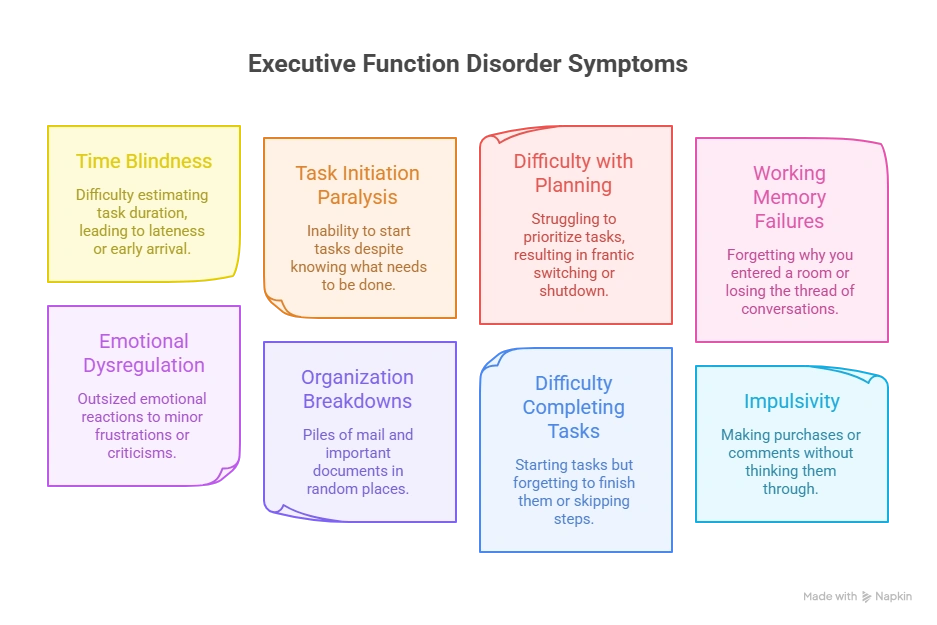
Signs and Symptoms of Executive Function Disorder In Adults
Executive dysfunction in adults often gets mistaken for laziness, carelessness, or lack of motivation. The symptoms are real neurological deficits, not character flaws.
Time blindness. Adults with executive dysfunction struggle to estimate how long tasks will take. They consistently run late, miss deadlines, or arrive 45 minutes early because they can’t gauge the passage of time. A 2019 study published in the Journal of Attention Disorders found that adults with ADHD showed significant impairments in time perception and time-based prospective memory compared to controls.
Task initiation paralysis. Knowing exactly what needs to be done and being physically unable to start. The dishes sit in the sink. The email draft stays open for three days. The project with a Friday deadline doesn’t get touched until Thursday night. This isn’t procrastination in the traditional sense. Procrastination involves choosing to delay. Task initiation failure feels involuntary.
Difficulty with planning and prioritization. When five tasks need to happen today, someone with executive dysfunction may struggle to determine which one matters most. Everything feels equally urgent or equally unimportant. The result is either frantic switching between tasks or complete shutdown.
Working memory failures. Walking into a room and forgetting why. Losing the thread of a conversation. Forgetting a commitment made 20 minutes earlier. Reading a page of text and retaining none of it.
Emotional dysregulation. Reactions that feel too big for the situation. A minor criticism from a coworker ruins the entire day. A small frustration, a jar lid that won’t open, a phone call that goes to voicemail, triggers an outsized emotional response. The feelings pass, but the intensity is hard to control in the moment.
Organization breakdowns. Piles of mail accumulate. Important documents end up in random places. The desk, the car, the kitchen counter all become collection points for items that never get put away.
Difficulty completing multi-step tasks. Starting laundry and forgetting to move it to the dryer. Beginning a recipe and skipping steps. Starting three projects simultaneously and finishing none.
Impulsivity. Making purchases without thinking them through. Blurting out comments in conversations. Making commitments without checking the calendar.
These symptoms create secondary problems:
Poor performance at work. Strained relationships. Chronic shame and low self-esteem. Financial difficulties from disorganized bill-paying or impulsive spending. Social isolation from missed plans and forgotten commitments.
What causes executive dysfunction?
The prefrontal cortex, the front section of the brain, manages executive function. Any condition that affects this region can produce executive dysfunction.
ADHD. The most common cause. ADHD involves differences in dopamine and norepinephrine signaling in the prefrontal cortex. These neurotransmitters play a direct role in attention, motivation, and impulse control.
Traumatic brain injury. Damage to the frontal lobe from accidents, falls, or impact injuries can produce executive dysfunction even in people who never had difficulties before the injury.
Depression. Major depressive disorder slows cognitive processing and impairs planning, decision-making, and motivation. Executive dysfunction during a depressive episode often improves when the depression is treated.
Anxiety disorders. Chronic anxiety occupies working memory. When the brain is consumed with worry, fewer cognitive resources remain for planning, organizing, and task completion.
Autism spectrum disorder. Many autistic individuals experience difficulties with cognitive flexibility, the ability to shift between tasks or adapt when plans change.
Neurodegenerative diseases. Alzheimer’s disease, frontotemporal dementia, Parkinson’s disease, Huntington’s disease, and multiple sclerosis can all damage areas of the brain responsible for executive function.
Chronic sleep deprivation. Sleep deprivation impairs the prefrontal cortex before it affects any other brain region. Adults averaging less than six hours of sleep per night show measurable executive function deficits.
Chronic stress. Prolonged cortisol exposure shrinks the prefrontal cortex over time. High-stress environments compound executive dysfunction in people who are already predisposed to it.
Substance use. Alcohol and certain drugs directly impair prefrontal cortex function, both acutely and with chronic use.
How executive dysfunction is evaluated and diagnosed
There is no single test for executive dysfunction. Evaluation involves ruling out other conditions, gathering behavioral data, and using standardized assessment tools.
Start with a self-screening. Before scheduling a formal evaluation, online self-assessments can help you determine whether your symptoms warrant professional attention. The ADDitude executive dysfunction self-test for adults is one of the most widely used free screeners. The ADDA adult ADHD self-screening tool, based on the World Health Organization’s ASRS v1.1, screens for ADHD symptoms that overlap with executive dysfunction. The ADEXI executive function self-assessment measures working memory and inhibitory control and takes about three minutes. None of these replace a clinical diagnosis, but they provide a starting point.
Common clinical assessment tools include:
Behavior Rating Inventory of Executive Function, adult version (BRIEF-A). A 75-item standardized measure that captures how executive function impacts everyday behavior in adults ages 18-90. It covers nine clinical scales including inhibit, shift, emotional control, self-monitor, initiate, working memory, plan/organize, task monitor, and organization of materials. The BRIEF-A takes 10-15 minutes to complete and has been validated across a wide range of clinical populations including ADHD, traumatic brain injury, autism, depression, and multiple sclerosis.
Barkley Deficits in Executive Functioning Scale (BDEFS). Designed specifically for adults. Uses self-report and observer reports to assess five major areas of executive function: self-management to time, self-organization/problem-solving, self-restraint, self-motivation, and self-regulation of emotions.
Conners 3. A rating scale that evaluates ADHD and executive function using parent, self, and teacher reports. Used more commonly for children and adolescents.
Comprehensive Executive Function Inventory (CEFI). Compares an individual’s executive functioning to a norm group using multiple report types.
The evaluation process typically includes:
A clinical interview covering developmental history, current symptoms, academic and work performance, and family history. Medical evaluation to rule out thyroid disorders, sleep apnea, vitamin deficiencies, and other physical conditions that can mimic executive dysfunction. Neuropsychological testing if a brain injury or neurodegenerative condition is suspected. The National Institute of Mental Health’s ADHD information page provides additional guidance on the diagnostic process.
If you suspect executive dysfunction, start with your primary care physician. They can perform initial screening and refer you to a neuropsychologist or psychiatrist for specialized evaluation. LDRFA’s learning disability assessment resource page can help you find evaluation options.
Treatment and management strategies
Treatment depends on the underlying cause. When executive dysfunction stems from ADHD, treatment usually combines medication with behavioral strategies. When it stems from depression or anxiety, treating the primary condition often improves executive function.
Medication. For ADHD-related executive dysfunction, stimulant medications (methylphenidate, amphetamine-based medications) remain the first-line treatment. They increase dopamine and norepinephrine availability in the prefrontal cortex. Non-stimulant options like atomoxetine and guanfacine are alternatives for people who don’t tolerate stimulants. The CDC’s ADHD treatment information page provides an overview of medication types and what to discuss with your provider. Always consult with a psychiatrist or physician before starting any medication.
Cognitive behavioral therapy (CBT). CBT helps people identify patterns that make executive dysfunction worse and build specific strategies to work around deficits. A 2026 meta-analysis published in the Journal of Affective Disorders, analyzing 70 studies with over 5,000 participants, found that CBT produced significant improvements in executive function (effect size of -0.43) for adults with ADHD. Group-based CBT formats showed the strongest effects on executive function specifically, while individual CBT was more effective for emotional dysregulation and quality of life. Research from Frontiers in Psychiatry found that CBT adapted for ADHD, which includes environmental engineering and executive function skills training, produces better outcomes than generic CBT.
Executive function coaching. A specialized form of coaching that focuses on building systems for time management, organization, and task completion. The coach provides accountability and helps the individual implement strategies tailored to their specific deficits. The ADHD Coaches Organization maintains a directory of certified coaches.
Environmental modifications. Making the external environment compensate for internal deficits. This includes making time visible (analog clocks in every room, timer apps), making tasks visible (whiteboard to-do lists, sticky notes, digital task managers), and reducing decision load (simplified routines, pre-set outfits, automated bill pay). LDRFA’s assistive technology tools page covers many of the specific tools and apps designed to support these modifications.
Impact of Executive Dysfunction on Daily Life Activities
These are concrete approaches that adults with executive dysfunction use to manage daily responsibilities. None of them “cure” executive dysfunction. They compensate for it.
Time management. Use timers for everything. Set a 10-minute timer before a task to create a start deadline. Use time-blocking in a calendar where each hour has an assigned activity. Over-estimate how long tasks will take by 50%. If you think something will take 20 minutes, schedule 30.
Task initiation. The “two-minute rule” works: if something takes less than two minutes, do it immediately. For larger tasks, commit to working for just five minutes. The barrier is starting, not sustaining. Once the brain engages, momentum carries forward.
Organization. One inbox for physical mail. One place for keys, wallet, and phone (every single time). Digital tools like Todoist, Trello, or Google Keep for task tracking. The system matters less than consistency.
Working memory. Write everything down. Not in your head, on paper or in an app. If someone tells you something important, capture it immediately. Voice memos on your phone take three seconds.
Emotional regulation. Recognize the pattern: trigger, intense emotion, regret. Building a pause between trigger and response, even a five-second pause, reduces the intensity. Physical movement (walking, stretching) during emotional spikes helps regulate the nervous system.
Decision-making. Reduce choices. Meal planning on Sunday eliminates daily “what’s for dinner” decisions. Set up automatic payments for recurring bills. Use templates for routine emails. Every automated decision saves cognitive bandwidth for decisions that matter.
Recognizing the pervasive impact of executive dysfunction on these essential aspects of daily life is crucial for developing tailored strategies and interventions to support individuals in managing and mitigating these challenges.
Technology Tools to Support Executive Function Skills
Several technology tools are available to support and enhance executive function skills, including:
Task Management Apps:
- Todoist: A popular task management app that helps individuals organize tasks, set deadlines, and prioritize activities.
- Trello: Enables users to create visual boards to manage tasks and projects, enhancing organization and task prioritization.
- Asana, and Google Tasks help break projects into steps and set deadlines with reminders.
Time Management Apps:
- Toggl: A time-tracking app that assists in managing and analyzing time spent on different activities, aiding in time management and productivity improvement.
- RescueTime: Monitors computer and mobile usage, providing insights into time allocation and helping users identify time-wasting activities.
Mind Mapping Software:
- MindMeister: Facilitates the creation of visual mind maps to organize thoughts, ideas, and information, enhancing brainstorming and planning capabilities.
- Coggle.It – Make mind map documents that flow like your ideas.
Digital Calendars:
- Google Calendar: A widely used digital calendar for scheduling appointments, setting reminders, and managing daily, weekly, and monthly activities.
Note-Taking Apps:
- Evernote and Notion for capturing information across devices. Voice memo apps for quick capture when typing isn’t practical.
Focus and Attention Apps: Noise-canceling headphones for reducing environmental distractions.
- Focus@Will: Provides personalized music channels designed to improve focus, attention, and productivity during work or study sessions.
- Website blockers like Freedom or Cold Turkey during work sessions.
Speech-to-Text Tools:
- Dragon NaturallySpeaking, Google Voice Typing, and Apple Dictation for people who find writing difficult but can articulate their thoughts verbally. See LDRFA’s speech-to-text tools guide for a full comparison.
Mind Mapping:
- MindMeister, Coggle, and XMind for visual thinkers who organize ideas better in spatial layouts than linear lists.
Executive Function Disorder in Adults: Coping Mechanisms
Living with executive function disorder as an adult can present various challenges in managing daily responsibilities and tasks. However, there are several effective coping mechanisms that can help individuals navigate these difficulties and improve their overall quality of life.
Use of Visual Aids:
- Utilizing visual aids such as calendars, to-do lists, and color-coded schedules can assist in organizing and prioritizing tasks, deadlines, and appointments.
Time Management Strategies:
- Implementing time management techniques such as breaking down tasks into smaller steps, setting specific time limits for activities, and using timers or alarms can aid in staying focused and meeting deadlines.
Utilizing Technology Tools:
- Leveraging technology tools such as organization apps, reminder systems, and productivity software can support individuals in managing their daily routines and responsibilities effectively.
Seeking Professional Support:
- Consulting with mental health professionals, occupational therapists, or executive function coaches can provide tailored strategies and support to address specific challenges associated with executive function disorder.
Establishing Routines and Structures:
- Creating consistent daily routines, establishing organizational systems for home and work environments, and breaking tasks into manageable steps can help in managing executive function difficulties.
Self-Care Practices:
- Engaging in stress-reducing activities, maintaining a healthy lifestyle, and practicing mindfulness and relaxation techniques can support overall well-being and cognitive function.
Using these coping mechanisms in their daily lives, adults with executive function disorder can enhance their ability to manage tasks, improve productivity, and navigate the challenges associated with this condition.
Executive dysfunction vs. ADHD: what’s the difference?
ADHD is a neurodevelopmental disorder. Executive dysfunction is a symptom that appears across multiple conditions.
Every person with ADHD experiences executive dysfunction to some degree. But not every person with executive dysfunction has ADHD. The overlap is significant enough that ADHD has been described as a developmental impairment of executive functions, but the two terms aren’t interchangeable.
Other conditions that cause executive dysfunction include depression, anxiety disorders, bipolar disorder, autism spectrum disorder, obsessive-compulsive disorder, traumatic brain injuries, stroke, Alzheimer’s disease, and other neurodegenerative conditions. Chronic sleep deprivation and prolonged stress can also impair executive functioning in people without any diagnosed condition.
The distinction matters for treatment. If executive dysfunction comes from untreated depression, addressing the depression improves executive function. If it comes from ADHD, the treatment path involves different medications and behavioral strategies.
The relationship between executive dysfunction and ADHD
ADHD is the most studied and most common cause of executive dysfunction. Understanding how they interact helps with treatment decisions. For a deeper look at how ADHD manifests in adults, see LDRFA’s guide to adult ADHD symptoms and treatment.
People with ADHD are often 30-40% behind their peers in executive function development. A 25-year-old with ADHD may have the executive function capacity of a 17 or 18-year-old. This developmental delay isn’t about intelligence. IQ and executive function are separate systems. Research by Friedman et al. (2008) found that individual differences in executive functions are almost entirely genetic in origin, which helps explain why ADHD and executive dysfunction run in families.
The connection also goes the other direction. Executive dysfunction worsens ADHD symptoms. When planning and prioritization break down, the inattentive symptoms of ADHD become more visible. When emotional regulation fails, the impulsive symptoms intensify. LDRFA’s article on understanding comorbidities in learning disabilities explains how these overlapping conditions affect one another.
Treatment that targets both ADHD and executive dysfunction directly produces better outcomes than treating either one alone. Medication addresses the neurochemical side. CBT and coaching address the behavioral and strategic side. ADDitude Magazine’s guide to executive dysfunction provides additional perspective on this relationship from a clinical standpoint.
When to seek professional help for Executive Dysfunction
Executive dysfunction exists on a spectrum. Everyone forgets things, loses track of time, and procrastinates occasionally. It becomes a clinical concern when it consistently interferes with work performance, relationships, financial management, or daily self-care.
If you recognize the patterns described in this article and they’re disrupting your daily life, an evaluation is worth pursuing. Start with a self-screening tool like the ADDitude executive dysfunction test for adults or the ADDA adult ADHD screening tool. If the results suggest significant difficulties, schedule an evaluation with a neuropsychologist or psychiatrist who can identify whether executive dysfunction is present, determine its cause, and recommend a treatment plan.
The Cleveland Clinic’s executive dysfunction resource and Medical News Today’s guide to executive function disorder offer additional clinical perspectives on diagnosis and treatment options.
LDRFA provides resources, information, and support for individuals with learning disabilities and attention disorders. Visit our assistive technology tools page for tools that support executive function, explore our ADHD and learning disability facts, or contact our helpline for guidance on next steps.
What’s Next?
It’s important to know that executive function disorder is not a life sentence and that with the right treatment plan, the symptoms can be properly managed. If you have any questions about executive function disorder, comment below. And, check out this inspiring article to learn how John Chambers, who struggles with dyslexia, became the CEO of Cisco.
Frequently asked questions Abut Executive Dysfunction
Can you develop executive dysfunction as an adult?
Executive dysfunction can emerge in adults who didn’t have it as children. Brain injuries, stroke, neurodegenerative diseases, chronic sleep deprivation, and severe depression can all cause executive function impairment in adulthood. However, when executive dysfunction stems from ADHD, the symptoms were present in childhood, even if they weren’t recognized.
Does executive dysfunction go away?
It depends on the cause. Executive dysfunction caused by a depressive episode often improves with treatment. Executive dysfunction from ADHD is lifelong but manageable with medication, therapy, and environmental strategies. Executive dysfunction from brain injury or neurodegenerative conditions varies based on the severity and progression of the underlying condition.
What is the difference between executive function disorder and executive dysfunction?
The terms are often used interchangeably. “Executive function disorder” (EFD) is sometimes used as a standalone diagnosis, but it is not a formally recognized disorder in the DSM-5. “Executive dysfunction” more accurately describes a symptom that occurs across multiple conditions, including ADHD, depression, traumatic brain injury, and autism.
How is executive dysfunction treated?
Treatment targets the underlying cause. For ADHD, stimulant medications combined with cognitive behavioral therapy and executive function coaching produce the best outcomes. For depression-related executive dysfunction, antidepressants and therapy are the primary approach. Environmental modifications, like external reminder systems, visual schedules, and reduced decision load, help across all causes.
Can executive dysfunction affect relationships?
Yes. Forgotten plans, missed commitments, emotional reactivity, difficulty following through on promises, and disorganized shared living spaces all strain relationships. Partners of adults with executive dysfunction often feel they carry a disproportionate share of household management. Couples therapy that addresses executive function challenges directly can improve relationship outcomes.
Executive Dysfunction Resources
- Executive Dysfunction – Cleveland Clinic Executive Function Information Guide.
- Disordered Executive Function: What To Know – Medical News Today
- Barkley, R.A. (2012). Executive Functions: What They Are, How They Work, and Why They Evolved. Guilford Press.
- Elliot, R. (2003). Executive functions and their disorders: Imaging in clinical neuroscience. British Medical Bulletin, 65(1), 49-59.
- Friedman, N.P., et al. (2008). Individual Differences in Executive Functions Are Almost Entirely Genetic in Origin. Journal of Experimental Psychology: General, 137(2), 201-225.
- Liu, Y., et al. (2026). A meta-analysis of the intervention effect of cognitive behavioral therapy on adult ADHD. Journal of Affective Disorders.
- Roth, R.M., Isquith, P.K., & Gioia, G.A. (2005). Behavior Rating Inventory of Executive Function, Adult Version (BRIEF-A). Psychological Assessment Resources.
- Ramsay, J.R. (2012). CBT for Adult ADHD: Adaptations and Hypothesized Mechanisms of Change. Journal of Cognitive Psychotherapy, 24(1), 37-45.
- Puente, A.N. & Mitchell, J.T. (2016). Cognitive-Behavioral Therapy for Adult ADHD. Journal of Contemporary Psychotherapy, 46(2).
- National Institute of Mental Health: ADHD.
- Cleveland Clinic: Executive Dysfunction.
- Medical News Today: Executive Function Disorder.
- CDC: ADHD Treatment.
Summary
Executive function disorder (EFD) can significantly impact an individual’s cognitive abilities, behavior, and daily functioning. It’s important to recognize EFD symptoms and seek appropriate evaluation and support, especially because EFD is often symptomatic of other neurological, mental health, and behavioral disorders.