

Hispanic Students Achievement Gap
Across the United States, Hispanic students are working to master complex academic skills while simultaneously learning English—a challenge that often masks their true potential.
Too often, language barriers are mistaken for learning disabilities, leading to misidentification and missed opportunities. Understanding the difference is essential to ensuring that every child receives the right kind of support to succeed.
Hispanic students now represent 28% of the U.S. student population (National Center for Education Statistics), making them the fastest-growing demographic in our schools. Yet these children face a unique challenge: mastering complex mathematical concepts while simultaneously acquiring English proficiency. This “double burden” creates significant barriers to academic success and too often leads to misidentification of learning disabilities.
A groundbreaking study from Frontiers in Psychology offers hope. Researchers tested a comprehension-focused intervention with 43 third-grade Hispanic children who struggled with math word problems. The results demonstrate that targeted support addressing both language and cognitive demands can close achievement gaps. This evidence challenges us to rethink how we support English learners in mathematics—and provides a blueprint for doing it effectively.
Why English Learners Struggle in Mathematics
The statistics are stark. Hispanic fourth-graders score 25 points lower in mathematics than their non-English learner peers. By eighth grade, that gap widens to 41 points. These aren’t just numbers—they represent thousands of capable students falling behind through no fault of their own.
The consequences extend beyond test scores. In California alone, 61 districts showed significant disproportionality in special education placement for Latinx students during 2018-2019, primarily for Specific Learning Disability classifications.
The identification problem cuts both ways: Black and Hispanic students may be over-identified in predominantly white schools but under-identified in schools where they constitute the majority. We need better tools to distinguish genuine learning disabilities from the natural challenges of learning academic content in a second language.
Please Support. Together, we can make a difference!
Math Word Problems Language Barriers
Mathematical word problems demand three simultaneous cognitive processes: mathematical reasoning, reading comprehension, and language processing. This triple demand creates excessive cognitive load on working memory, especially for students still developing English proficiency.
Consider what happens when an English learner encounters “Maria has three-fifths of a pizza.” Before solving anything, the child must decode “three-fifths,” understand the possessive “has,” and visualize the mathematical relationship—all while holding the problem structure in mind. Each linguistic hurdle consumes cognitive resources needed for mathematical thinking.
The challenge intensifies because in the US one survey reported that 51% of educators said they or the teachers they supervise received no professional development on how to engage English Learners’ families; and 57% said they lacked training. Source: Education Week
Without proper training, even well-intentioned educators struggle to distinguish whether a student’s difficulty stems from language barriers or actual mathematical learning disabilities. The result? Students either get inappropriate special education referrals or miss intervention they genuinely need.
Comprehension Intervention for Hispanic Students
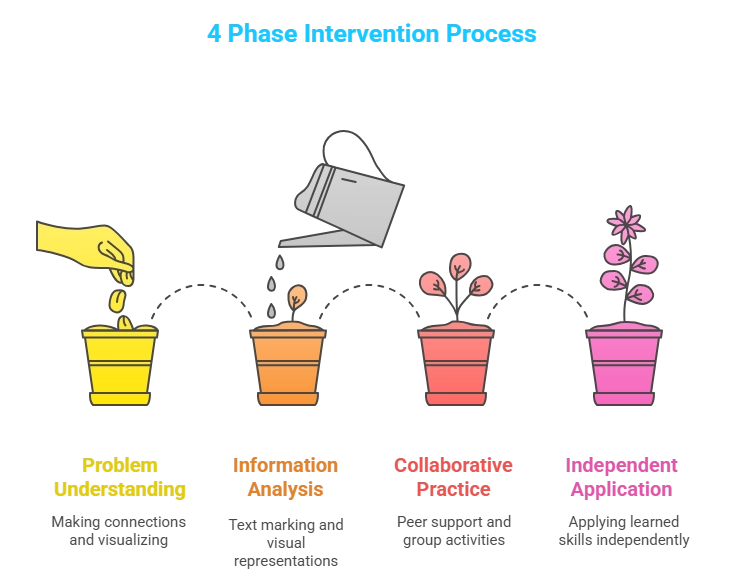
The featured study tested a four-phase intervention with 43 third-grade Hispanic children experiencing mathematical difficulties, compared against 32 control peers in the southwestern United States.
Phase 1 focused on problem understanding through making connections, visualization, and metacognitive monitoring.
Phase 2 taught information analysis using text marking and visual representations.
Phase 3 introduced collaborative practice with peer support.
Phase 4 built toward independent application.
The results exceeded expectations. Students in the intervention group showed medium effect sizes across multiple assessments (g = 0.59-0.70)—substantially higher than average effects for similar interventions. More importantly, the study revealed that reading comprehension emerged as a stronger predictor of success than working memory capacity. This finding fundamentally challenges assumptions about what drives mathematical difficulty in English learners.
Making Math Easier to Understand
The intervention worked by removing unnecessary mental obstacles—the brain power students waste trying to decode confusing instructions instead of actually learning math. By clearly teaching vocabulary and breaking down information step-by-step, students could focus their energy on understanding the math itself, not figuring out what they were supposed to do.
Reading and math skills support each other. When students read better, they solve math problems more easily. When they practice math reasoning, their overall reading comprehension improves too.
The research shows that for English learners, language understanding isn’t just helpful for math—it’s the foundation everything else builds on. Without it, students struggle with all aspects of learning, no matter how strong their number skills are.
Classroom Strategies for English Learners
Educators should:
- Integrate comprehension strategies directly into math instruction rather than treating them as separate skills
- Provide explicit vocabulary instruction for mathematical terms, including multiple exposures and visual supports
- Use structured problem-solving routines that reduce cognitive load
- Implement collaborative learning structures that allow students to process problems verbally
- Distinguish language challenges from learning disabilities through culturally responsive Multi-Tiered System of Supports
Parents can:
- Ask children to verbalize their thinking process when solving problems
- Practice retelling word problems in their own words before attempting solutions
- Create visual representations together—drawings, diagrams, or physical objects
- Support bilingual development by maintaining the home language while building English
- Advocate for appropriate assessment if difficulties persist despite good instruction
Educational Equity for Hispanic Children
This research proves that Hispanic English learners can succeed in mathematics when we address their actual learning needs rather than misidentifying language acquisition as disability. The intervention required no expensive technology or extensive resources—just informed instruction targeting the real barriers these students face.
We must train teachers in both English language development and special education, equip them to distinguish language barriers from learning disabilities, and implement culturally responsive support systems. Districts need policies ensuring English learners receive appropriate intervention before special education referral. In one stark example, Latino children in Santa Barbara were 3.43 times more likely to be identified with learning disabilities than their white peers.
Most critically, we must recognize that these children aren’t failing—our systems are failing them. When we provide targeted support addressing both linguistic and cognitive demands, English learners demonstrate mathematical competence that was always present but previously inaccessible. The question isn’t whether Hispanic students can succeed in mathematics. The question is whether we’ll finally provide the support that makes success possible.
Conclusion
As the Hispanic student population grows, so does the need to address how language acquisition intersects with learning challenges. Recent studies highlight that many mathematical learning difficulties among English learners stem from linguistic, not cognitive, barriers. Recognizing this distinction is key to developing effective interventions that promote equity and achievement.
To truly help Hispanic children succeed, we must ensure every teacher is equipped to recognize the difference between a learning disability and a language learning need. This means investing in professional development, culturally responsive teaching, and evidence-based interventions that empower both students and educators.
The data tells us what’s possible. Now it’s up to us to turn that possibility into practice—so every Hispanic student has the opportunity to show their full potential in mathematics and beyond.
Source:
Frontiers in Psychology: Comprehension strategy instruction for Hispanic children with mathematical learning difficulties